From Excel to Intelligent Systems: When Your Business Outgrows Its Spreadsheets
The AI Loop · 21 October 2026
Excel probably isn’t the problem. What your business depends on it for might be. How to spot when you’ve outgrown spreadsheets and what comes next.
Excel probably isn't the problem. What your business has come to depend on it for might be.
It often starts innocently enough. Someone creates a spreadsheet to track enquiries, manage orders, monitor finances or produce a weekly report. It works, so the team keeps using it. Another spreadsheet appears to solve a different problem, then another, until the business is relying on a collection of files, formulas and manual processes that nobody originally intended to become its operating system.
For many UK SMEs, this is how complexity creeps in. The business grows, the workload increases, but the way information moves around the organisation remains much the same. And eventually, the very tools that helped the business get started beginning to limit what it can do next.
When a spreadsheet becomes a business system
There is nothing inherently wrong with Excel. It is flexible, familiar and incredibly useful for analysing information, exploring ideas and handling many everyday tasks. The trouble starts when spreadsheets become the place where critical business information lives, decisions are recorded and processes depend on someone remembering exactly what to do next.
Perhaps several people maintain different versions of the same file. Maybe someone spends hours copying figures from one system into another before a report can be produced. Perhaps a key process works perfectly well until the person who understands the formulas is on holiday.
These are not simply spreadsheet problems. They are signs that the business may have outgrown the way it manages information and gets work done.
The question isn't whether you should stop using Excel. It's whether Excel is doing a job that your business now needs a better system to handle.
The hidden cost of keeping everything connected manually
One of the biggest costs of disconnected systems is the work that happens between them.
A customer enquiry arrives by email. Someone copies the details into a spreadsheet. The information is entered again into an accounts package or CRM. A colleague updates another file, and somebody else gathers the figures to produce a report.
Each individual step might seem reasonable. But multiply those steps across dozens or hundreds of transactions, and the business can spend a surprising amount of time moving information around instead of using it.
There is also the risk of errors, outdated information and decisions being made from incomplete figures. When people have to check several places to understand what is happening, getting a reliable picture of the business becomes harder than it should be.
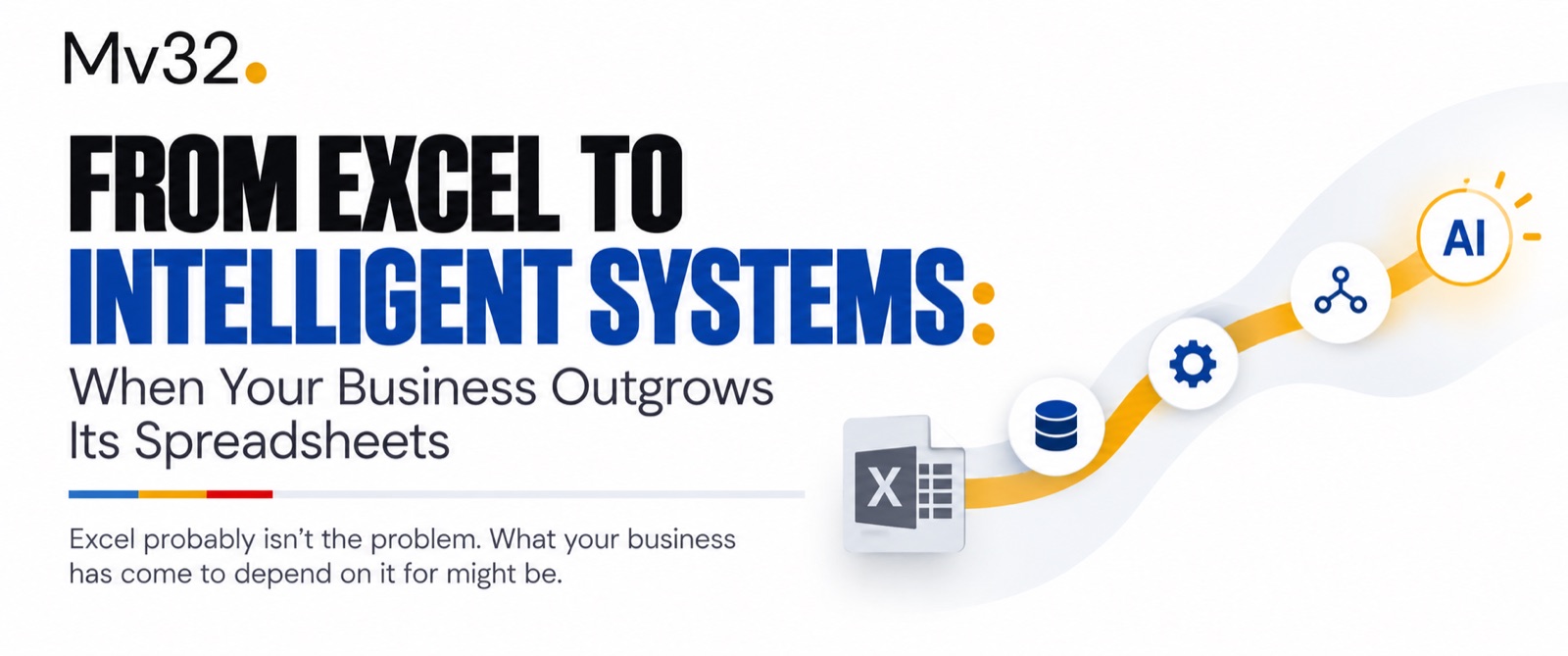
Don't replace Excel with another problem
The answer isn't automatically to buy a new software package. Replacing a spreadsheet with a more expensive system, without understanding the process behind it, can simply move the problem somewhere else.
Start by looking at how the business actually works. Which information is entered more than once? Where do delays occur? Which reports take too long to prepare? What happens when someone is unavailable? And which decisions are difficult because the information needed to make them is scattered across different places?
Those questions help identify what needs to change. Sometimes a spreadsheet is still the right tool. Sometimes a standard business application will do the job. In other cases, connecting existing systems or building a small, bespoke solution may make more sense.
The aim is not to introduce technology for its own sake. It is to create a way of working that is simpler, more reliable and easier to manage as the business grows.
From spreadsheets to intelligent systems
This is where I believe the opportunity becomes much more interesting.
Imagine your customer information being recorded once and then made available wherever it is needed. Orders, invoices and operational updates flow between the systems that support the business. Reports draw on consistent information rather than relying on someone to assemble figures manually.
Once those foundations are in place, automation can take care of repetitive steps, while AI can help people find information, analyse patterns, prepare reports and make better-informed decisions.
But the order matters.
Get the data right. Connect the systems. Automate the routine work. Then introduce AI where it adds value.
AI cannot magically make unreliable information trustworthy or turn a broken process into a good one. It needs access to useful information and a clear understanding of the task it is helping with.
The goal is not a business that uses the most technology. It is a business where the technology works together, routine tasks require less manual effort, and people have more time to focus on customers, decisions and growth.
Your business may be ready for the next step
If your team relies heavily on spreadsheets, that doesn't mean you have done anything wrong. In many businesses, spreadsheets are a practical response to changing needs, limited budgets and software that doesn't quite fit the way people work.
The important thing is recognising when the workaround has become the process.
You don't have to transform everything at once. Start with one area where manual work is consuming time, information is difficult to find, or a process depends too heavily on one person. Understand the problem, identify the options and make a considered improvement.
At Mv32, this is how I approach technology: start with the business, not the tool. The right answer might be better use of existing software, connecting systems, automation, bespoke development or AI. The objective is to find what genuinely makes the business work better.
Where should you start?
If you're wondering whether your business is ready to move beyond spreadsheet-heavy processes, I've created two ways to take the next step.
First, try the AI Readiness Scorecard. It is a practical starting point for assessing where your business stands and identifying areas worth exploring.
👉 Take the scorecard: AI Readiness Scorecard
If you already know that your systems, data or processes need attention, you can also book a free 30-minute discovery call with me. We can discuss how your business currently works, where the friction sits and what a sensible next step might look like.
No obligation. Just a practical conversation about what could work for your business.
One question to leave you with:
What's the one spreadsheet in your business that everyone depends on, but nobody would want to be responsible for fixing?
Originally published in The AI Loop on LinkedIn.
Could AI take the busywork off your plate?
Book a free 30-minute discovery call with Simon. No pitch, just an honest look at where your time goes and what could change.
Book a discovery callI post on LinkedIn every day about practical AI, running a small business and what I'm learning along the way. Connect with me there and join the conversation.
Connect on LinkedIn