Connected Business Systems: Your Business Shouldn't Have to Join the Dots
The AI Loop · 28 October 2026
Your business may have all the software it needs, yet people still move information between systems by hand. How connected systems remove that friction.
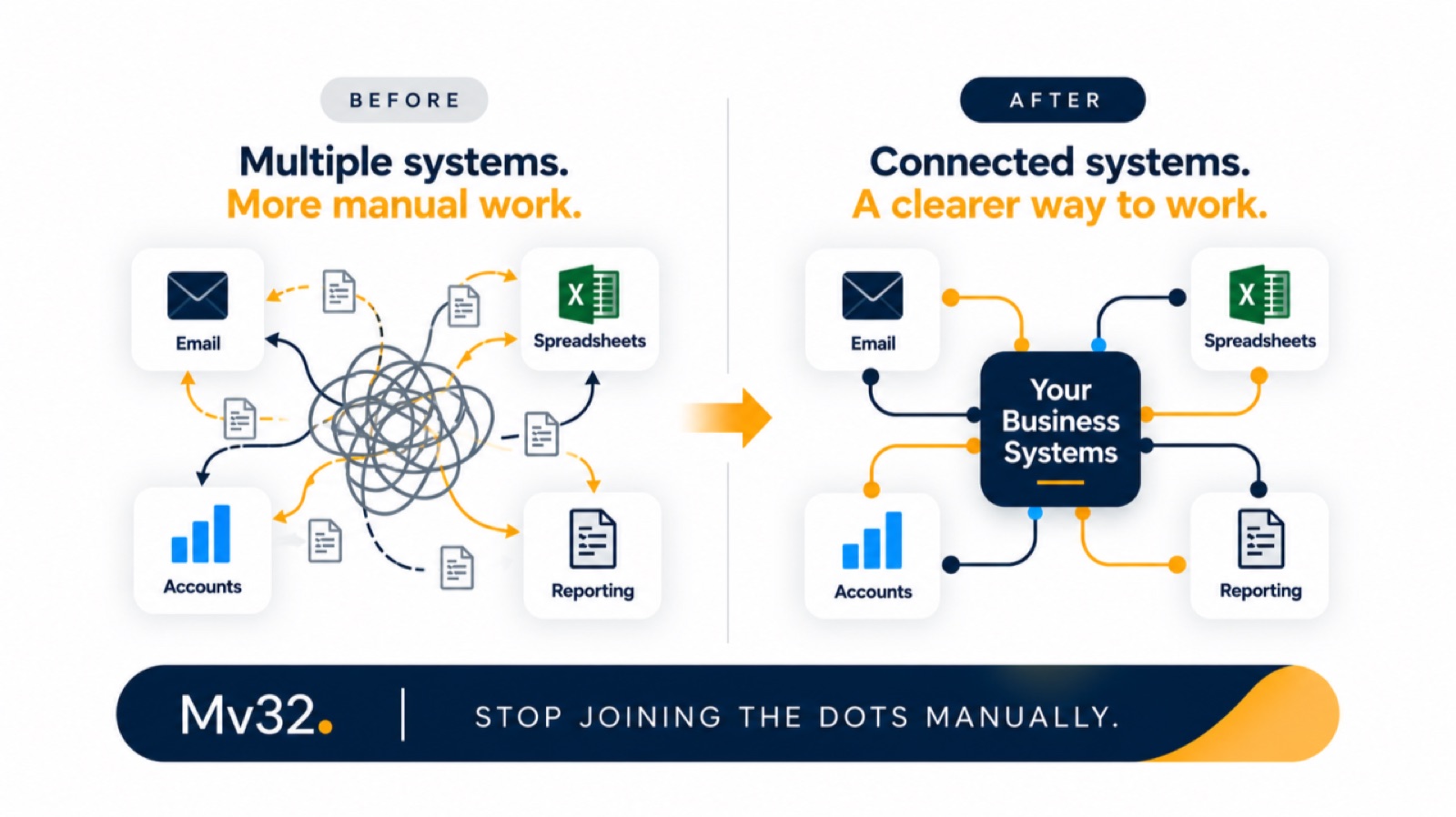
Your business might have all the software it needs. So why is so much work still being done manually?
A customer places an order. Someone updates a spreadsheet. Another person enters the details into the accounts package. A colleague checks a separate system to see whether the order has been processed, then pulls information together to produce a report.
Each system does its job. But somehow, your people are still spending time moving information between them.
For many small and medium-sized businesses, this is an everyday reality. Over time, different tools are introduced to solve individual problems, often without considering how they fit into the wider operation. Before long, the business has a collection of systems, but not necessarily a connected way of working.
The problem isn't always the software. It's what happens between it.
When disconnected systems become the problem
Most businesses don't set out to create complicated processes. They make sensible decisions as they grow. A spreadsheet fills a gap, a new application solves a particular challenge, and a manual workaround keeps things moving when two systems don't communicate.
Individually, these decisions make sense. Collectively, they can create friction that becomes increasingly difficult to manage.
Information gets entered more than once. Different teams work from different versions of the truth. Reports take longer to produce because someone has to gather information from several places. And when a key person is unavailable, a process that seemed straightforward suddenly becomes difficult to complete.
There is also a less obvious cost: the time people spend checking, correcting and chasing information instead of using it to serve customers, improve operations or make decisions.
When these problems become part of the normal working day, they can be easy to overlook. People develop workarounds and get on with the job. But the fact that a process works doesn't necessarily mean it works well.
The value of getting your systems to work together
Imagine information being entered once and then becoming available wherever it is needed.
A customer enquiry moves into the right workflow. Order information is available to the people handling fulfilment. Relevant financial data flows into the systems used by the accounts team. Management reports draw on consistent information rather than requiring someone to assemble everything manually.
This doesn't mean every application needs replacing, or that every process must be automated. Often, the better starting point is to understand what you already have and identify where information gets stuck.
Sometimes, connecting two existing systems can remove hours of repetitive work. In other cases, a standard application, a small bespoke solution or a redesigned process may be the better answer.
The objective is straightforward: less time moving information around, fewer opportunities for mistakes, and a clearer view of how the business is performing.
Get the foundations right before adding AI
Connected business systems also create opportunities for AI, but the order matters.
If your information is duplicated, incomplete or scattered across disconnected tools, introducing AI won't automatically resolve those issues. You may simply be adding another tool to an already complicated environment.
Start by understanding the data your business depends on. Establish where important information lives, who is responsible for it and how it moves through your processes. Then look at how existing systems could share information more reliably.
Once those foundations are in place, automation can handle appropriate repetitive tasks, while AI can help people find information, summarise activity, analyse patterns and make better-informed decisions.
The important point is that technology should work as part of the business, not become another layer of work that people have to manage.
You don't need to connect everything at once
The prospect of reviewing business systems can feel like a major project, especially when people are already busy running the business.
But you don't have to start with a complete technology overhaul. Start with one process that causes frustration.
Perhaps your team enters the same customer details into three different places. Perhaps producing a weekly report takes half a day. Perhaps nobody is entirely confident that the figures in one system match those in another.
Follow that process from beginning to end. Identify where information is created, where it is copied, where delays occur and where someone has to intervene simply to keep things moving.
Then ask what would make the process simpler and more reliable.
That exercise often reveals a more practical route forward than starting with a list of software products. It also helps you focus investment on a real business problem rather than buying technology in the hope that it will somehow improve things.
Build a business that works better
At Mv32, my starting point is always the business, not the technology.
I want to understand how the organisation works, where people lose time and what prevents them from doing their best work. Only then does it make sense to decide whether the answer is better use of existing software, connected systems, automation, bespoke development or AI.
The aim isn't to build the most technically sophisticated operation. It's to help a business work with less friction, make better use of its information and give people more time to focus on what matters.
Connected systems are an important part of that journey. They create the foundations for better visibility, more consistent processes and the effective use of AI as your business develops.
You don't need enterprise-level budgets to start making improvements. You need a clear understanding of the problem and a sensible plan for addressing it.
Where are your systems making work harder?
If your team spends too much time copying information between applications, reconciling spreadsheets or chasing updates, it may be worth looking at how your systems work together.
You can start by exploring where AI could help your business through the free Can AI Run Your Business? tool.
Or, if you already know that disconnected systems and manual processes are holding you back, you can book a free 30-minute discovery call to discuss your situation and possible next steps.
One question to leave you with:
What's the one piece of information your team has to enter, check or chase in more than one place?
I'd be interested to hear where the friction sits in your business.
Originally published in The AI Loop on LinkedIn.
Could AI take the busywork off your plate?
Book a free 30-minute discovery call with Simon. No pitch, just an honest look at where your time goes and what could change.
Book a discovery callI post on LinkedIn every day about practical AI, running a small business and what I'm learning along the way. Connect with me there and join the conversation.
Connect on LinkedIn