EXPAND WHAT’S POSSIBLE
The AI Loop · 16 September 2026
The real value of AI isn’t doing what you already do, faster. It’s doing things you couldn’t do before. The fifth principle of the IA framework.
The real value of AI isn’t doing the things you already do, faster. It’s doing things you couldn’t do before.
That distinction matters. Most conversations about AI in business still focus on productivity: write this email, summarise that document, analyse this spreadsheet, automate that repetitive task. All useful, certainly, but they are essentially improvements to an existing way of working. The much bigger opportunity comes when AI changes what the organisation is actually capable of doing.
That is the final step in my IA framework: EXPAND WHAT’S POSSIBLE.
The first four steps are about learning to work effectively with an Intelligent Assistant. YOU LEAD, IT FOLLOWS means your expertise remains in charge. BRIEF IT LIKE A PROFESSIONAL recognises that better instructions produce better results. WORK IN LOOPS, NOT LINES reminds us that good work develops through review and refinement. And TRUST BUT VERIFY keeps accountability where it belongs: with you.
Those four principles help you use AI well. But this final step asks a more interesting question: what becomes possible when you stop treating AI as simply an assistant for your existing workload?
FROM AUTOMATION TO CAPABILITY
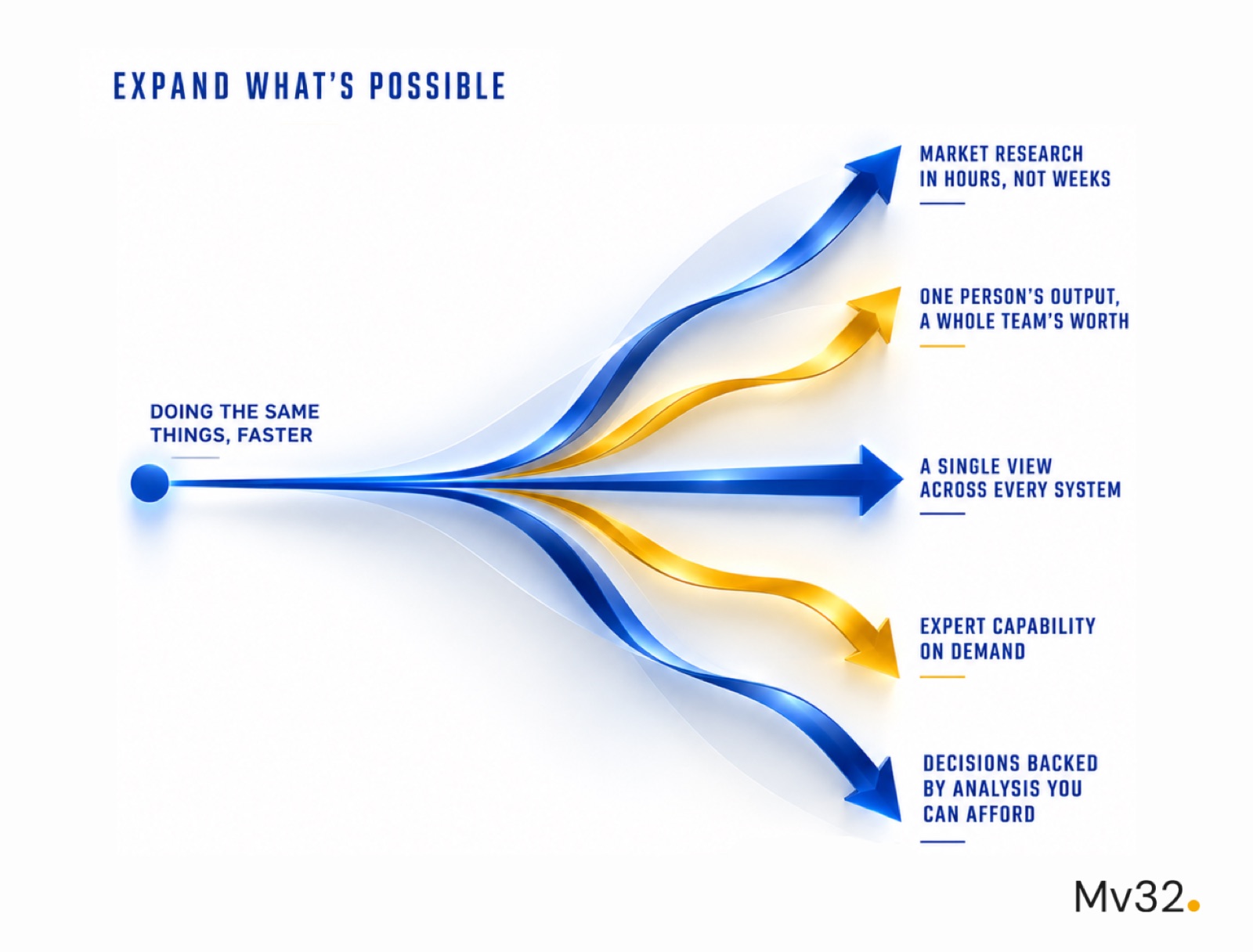
Imagine a business where a senior person can explore a new market without spending days gathering and organising information. Or where a small team can produce analysis, proposals and customer insight that previously required several people. Or where information scattered across systems can be brought together to give leaders a much clearer view of what is happening across the organisation.
These aren’t simply faster versions of existing tasks. They represent new organisational capabilities. AI can help smaller organisations access levels of analysis, automation, content creation and information processing that previously required significant amounts of time, specialist expertise or technology investment.
That is why I think the conversation about AI needs to move beyond productivity. Saving someone an hour is valuable. Giving an organisation the ability to do something it previously couldn’t do at all can be transformational.
THE QUESTION CHANGES
Once you understand this, the question you ask AI changes too.
Instead of asking, “How can AI help me do this task?”, start asking, “What could we do if AI was part of how this business operated?”
That opens up a very different conversation. You start looking at processes, information, customer interactions and decision-making as a connected system rather than a collection of individual tasks. You begin to spot opportunities that might never have appeared when the objective was simply to automate what already exists.
This is particularly important for SMEs. For years, sophisticated systems and capabilities were often associated with larger organisations because they had the budgets, specialist teams and resources to build them. AI is changing some of those economics. The opportunity is not necessarily to become a smaller version of a large enterprise, but to build a smarter organisation in which technology dramatically increases what a relatively small team can achieve.
DON’T AUTOMATE THE OLD WAY OF WORKING
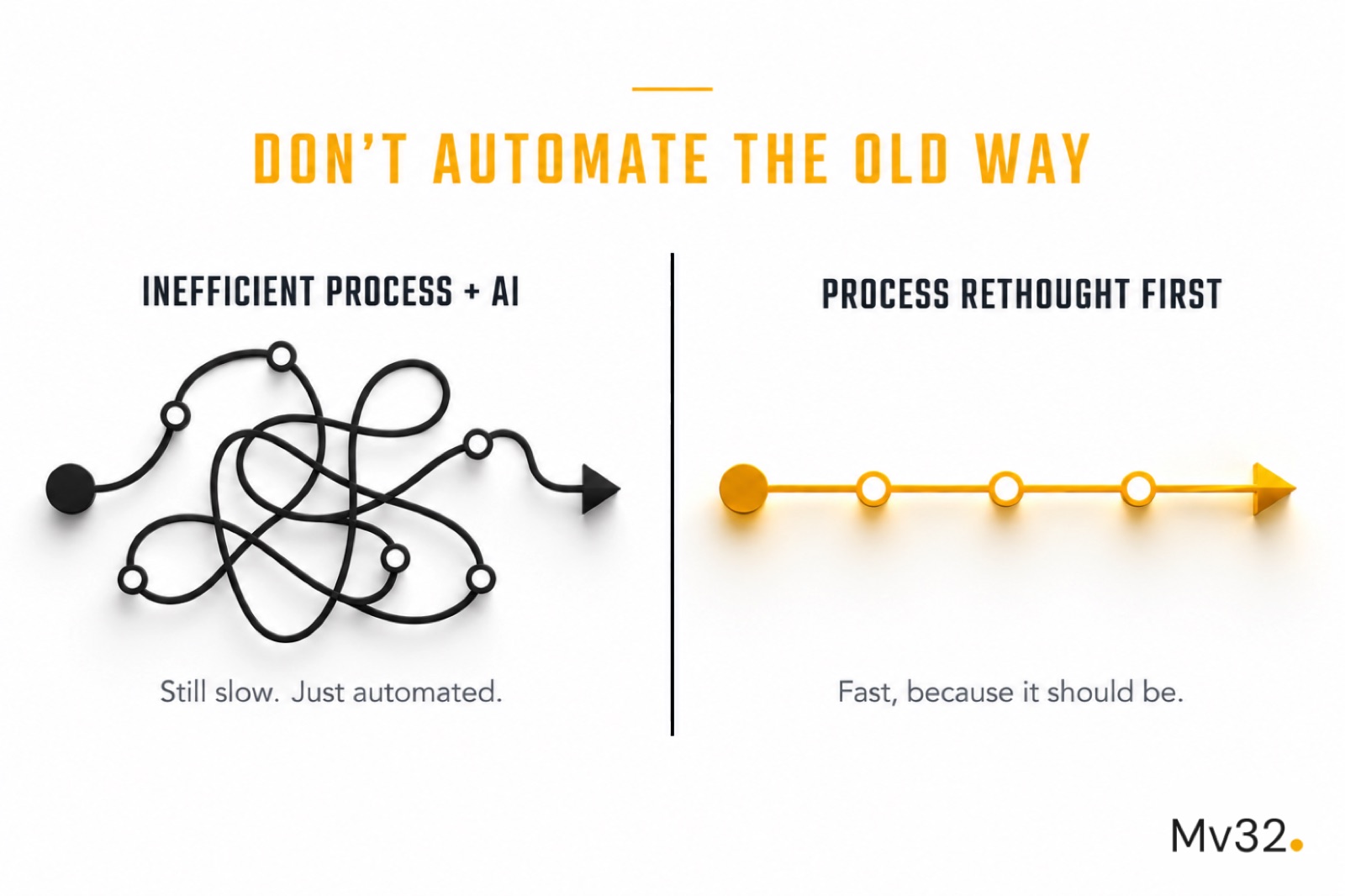
There is a trap here, though. If you simply take an inefficient process and add AI to it, you can end up with an automated inefficient process.
Expanding what’s possible requires stepping back first. What are we actually trying to achieve? Which parts of the current process exist because they genuinely add value, and which exist because that’s simply how we’ve always done things? What information could be connected? What decisions could be supported? What could happen automatically that currently requires someone to intervene?
The best opportunities often appear when you stop asking how to improve the existing process and start asking whether the process itself still makes sense.
YOUR IA SHOULD AMPLIFY YOUR THINKING
This brings us back to the principle behind the whole framework. Your Intelligent Assistant isn’t there to replace your expertise or make your decisions for you. You lead. It follows.
The point is to combine human judgement, experience and context with capabilities that AI can now provide at a scale and speed that were previously difficult to access. You bring the understanding of your customers, your organisation and your objectives. Your IA can help you explore possibilities, challenge assumptions, analyse information, develop options and turn ideas into something tangible.
And once you start working this way, the question becomes much bigger than “How can I use AI?”
It becomes: “What could my organisation achieve now that wasn’t practical before?”
That is where the real opportunity lies.
Not simply doing yesterday’s work faster.
Doing things you couldn’t do yesterday.
So, having worked through the five steps of the IA framework, I’d be interested to know:
What’s one thing your business could do if AI removed the constraint that is currently holding it back?
Originally published in The AI Loop on LinkedIn.
Could AI take the busywork off your plate?
Book a free 30-minute discovery call with Simon. No pitch, just an honest look at where your time goes and what could change.
Book a discovery callI post on LinkedIn every day about practical AI, running a small business and what I'm learning along the way. Connect with me there and join the conversation.
Connect on LinkedIn