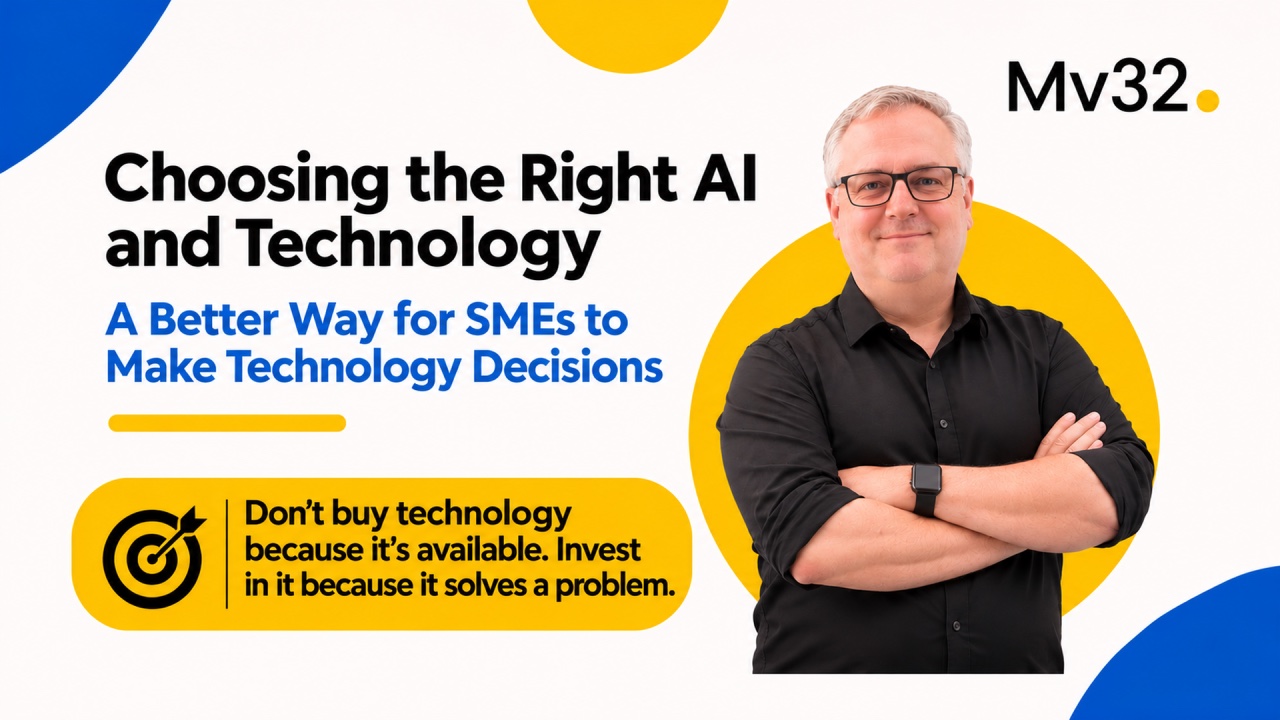
Choosing the Right AI and Technology: A Better Way for SMEs to Make Technology Decisions
The AI Loop · 25 November 2026
There has never been more choice when it comes to business technology. New AI platforms, automation tools, software subscriptions and digital solutions are appearing constantly.
There has never been more choice when it comes to business technology.
New AI platforms, automation tools, software subscriptions and digital solutions are appearing constantly. Each promises to make businesses more productive, efficient and competitive.
For small and medium-sized businesses, this presents an interesting opportunity. But it also creates a challenge.
With so many options available, how do you know which technology is right for your business?
My view is simple: Don't buy technology because it's available. Invest in it because it solves a problem.
The danger of following technology trends
It's easy to get caught up in the excitement surrounding new technology.
A business owner sees a demonstration of an AI tool, reads about a new platform or hears how another organisation has improved its operations.
The immediate reaction is often to explore the same solution.
But what works for one business may not work for another.
Different organisations have different processes, customers, systems, budgets and priorities.
Adopting technology without understanding these differences can lead to unnecessary subscriptions, complicated workflows and tools that employees rarely use.
The objective should never be to have the most technology. It should be to have the right technology.
Start with three important questions
Before investing in any new technology, I'd encourage business owners to consider three things.
What problem are we actually trying to solve?
Be specific.
Is your team spending too much time on administration? Are customer enquiries being missed? Is information scattered across different systems? Are managers struggling to get an accurate picture of business performance?
Understanding the problem makes it easier to identify an appropriate solution.
Can our existing systems already do this?
This is an important question that often gets overlooked.
Businesses sometimes purchase new software without fully understanding the capabilities of the systems they already use.
There may be opportunities to improve configuration, introduce integrations or automate existing processes without adding another platform.
How will we measure the value?
Technology should produce a meaningful business outcome.
That might be reduced administration, fewer errors, improved customer response times, better reporting or increased capacity.
If you cannot explain what success looks like, it becomes difficult to determine whether the investment was worthwhile.
AI isn't always the answer
AI has opened up some remarkable possibilities, particularly for smaller businesses.
It can help interpret information, generate content, classify enquiries, support customer service and assist with complex workflows.
However, not every business challenge requires AI.
Sometimes a straightforward automation is more reliable. Sometimes connecting two existing systems is all that's needed. In other situations, a process needs to be redesigned before any technology is introduced.
The skill is knowing which approach is appropriate.
Consider the bigger picture
Technology decisions should never be made in isolation.
A new system needs to work with existing processes, information and people.
Consider whether it integrates with your current software, whether your team can use it confidently, how information will be managed and what ongoing support will be required.
A solution that looks impressive during a demonstration may become an expensive complication if it doesn't fit the way the business operates.
Smaller businesses have a real opportunity
One of the most interesting developments in technology is that smaller organisations can now access capabilities that were once largely associated with much bigger enterprises.
AI, cloud platforms, automation and connected systems have made sophisticated business capabilities more accessible.
But access alone doesn't create an advantage.
The advantage comes from making informed decisions and implementing technology in ways that support the organisation's actual needs.
The question worth asking
Rather than asking, "Which AI tool should we buy next?", perhaps the better question is:
"What is the biggest problem holding our business back, and what is the simplest effective way to solve it?"
That change in perspective can make a significant difference.
At MV32, we help SMEs and charities explore how AI, connected systems and bespoke technology can improve the way they operate.
Our starting point isn't a particular tool. It's understanding the business.
Because technology should work for you, not give you another thing to manage.
You are the intelligence. AI is the assistant.
Simon Taylor MV32
Could AI take the busywork off your plate?
Book a free 30-minute discovery call with Simon. No pitch, just an honest look at where your time goes and what could change.
Book a discovery callI post on LinkedIn every day about practical AI, running a small business and what I'm learning along the way. Connect with me there and join the conversation.
Connect on LinkedIn