Can AI Run This Business?
The AI Loop · 7 October 2026
AI can now handle far more of a business’s work. The better question to ask, and why the answer should be a practical road map, not an AI wish list.
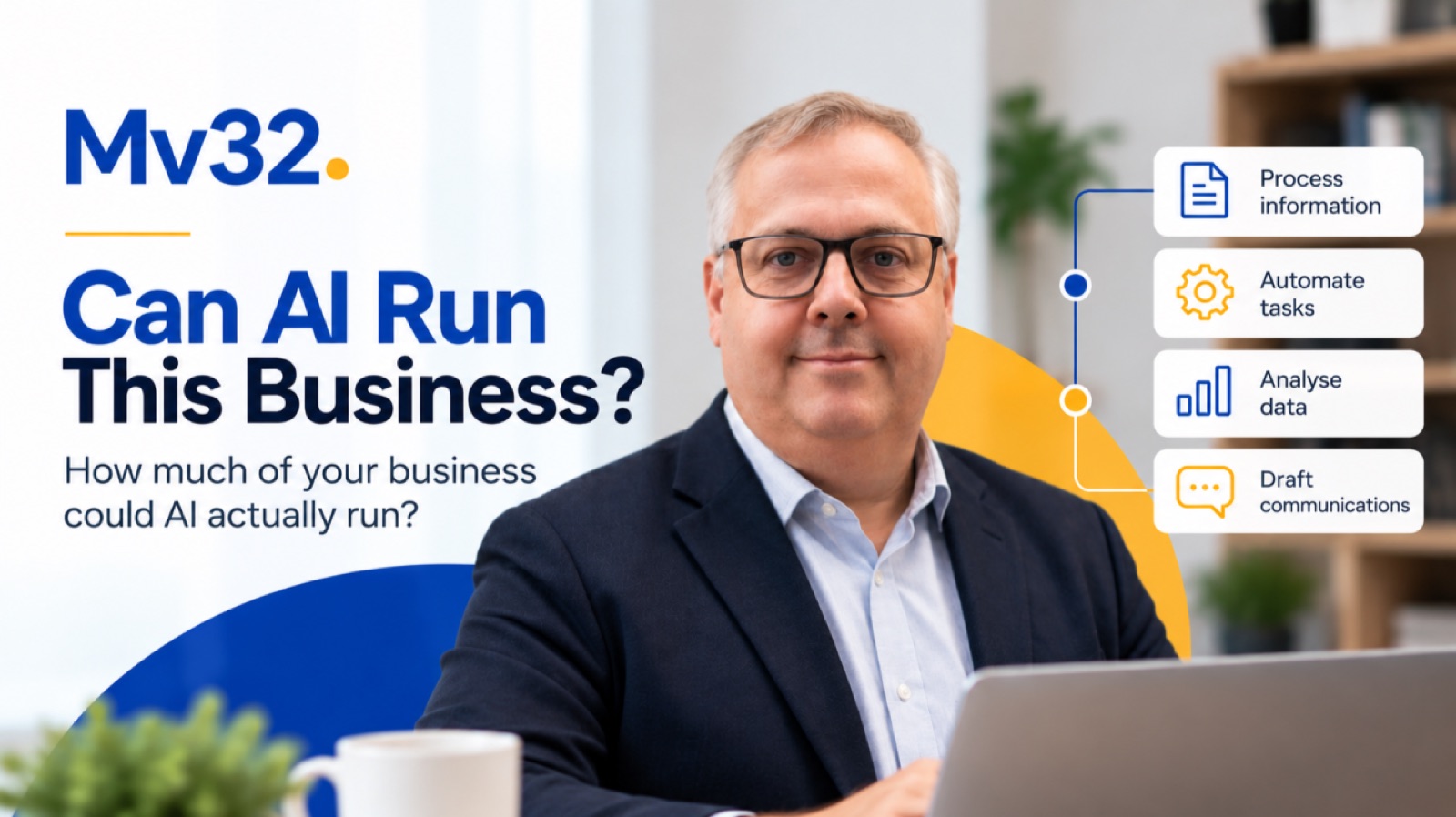
It is a question I've started asking businesses for a very practical reason.
AI can now do far more than write an email or summarise a document. It can analyse information, answer questions, draft documents, move information between systems, produce reports and support people through increasingly complex workflows.
So rather than asking, “How can we use AI?”, I think there is a better question:
“If we redesigned this business today, knowing what AI can now do, how much of the work could it actually handle?”
That is the thinking behind a series of reports I've started producing called “Can AI Run This Business?”
They are not AI wish lists. They are intended to be a road map for what a business could realistically become.
And there is a very important distinction.
AI can run a surprising amount of the work. But people still run the business.
This isn't a report about replacing people
The first thing I look at is what actually happens inside the organisation.
Where do enquiries come from? Where does information go? What gets entered more than once? Which processes depend on somebody remembering to do something? Where are people spending time answering questions, producing reports or moving information between systems?
Then I look at what AI and modern technology could realistically do with those processes.
Importantly, I don't assume everything should be automated.
Some things should remain human.
In fact, one of the most important parts of the work is identifying where human judgement needs to remain firmly in control.
I recently experimented with this principle in my own business by setting up Paperclip, an open-source tool for running a team of AI agents. I let the agents work over a weekend, and what impressed me most wasn't simply what they could do autonomously.
It was how the system brought decisions back to a person when a decision actually needed to be made.
That reinforced something fundamental about how I approach AI:
You are the intelligence. AI is the assistant.
The report turns an abstract idea into a business case
One of the problems with AI discussions is that they can remain incredibly abstract.
“AI could automate your business” sounds impressive.
But what does that actually mean?
Which processes?
Using what technology?
What would you need to build?
What can you simply buy?
What does it cost?
How long would it take?
What are the risks?
And, perhaps most importantly, where do you start?
That is what the “Can AI Run This Business?” report is designed to answer.
I recently produced one for a client, looking at how AI and modern business systems could transform the way their organisation operates.
The report didn't simply say, “Here are some AI tools you could use.”
It mapped the business into individual areas and considered whether each requirement should be bought off the shelf, connected to another system, or built specifically for the organisation.
That distinction can make an enormous difference.
In the example report, most of what the business needed already existed as commercial products. Only one significant component genuinely needed bespoke software. That immediately changed the scale of the project.
What initially sounded like “we need to build an AI system” became something much more manageable.
Buy most of it.
Connect what needs connecting.
Build only what is genuinely unique.
The roadmap matters more than the technology
Another important feature of the reports is that I don't recommend doing everything at once.
In the example I produced, the work was divided into three stages.
Stage one was about modernising the foundations.
Website and members' area. Customer records. Payments. Booking. A shared inbox. Getting the underlying information organised and making sure important content was current.
Stage two introduced AI.
A chatbot trained on the organisation's own material. Document generation. AI-assisted drafting. Better visibility and the beginnings of a more connected system.
Stage three was bespoke development.
But only if the evidence from stages one and two justified building it.
That last point is important.
I don't want to build software because I can.
I want to build it because the business has demonstrated that it needs it.
The report explicitly treats each stage as something that should stand on its own. If the earlier stages solve the problem, there is no obligation to continue.
That is a much more sensible way to approach technology investment than committing to a huge transformation project on day one.
Data first. Connected systems second. AI third.
There is another lesson that comes up repeatedly in this work.
Businesses often want to jump straight to AI.
I think that's backwards.
I've seen this at enterprise scale. Earlier in my career, I worked on systems where the biggest gains came from getting the underlying data and processes right.
At Castrol, I led a project to automate Excel-based reporting across Europe and Africa, covering 30 countries.
It saved more than 10,000 hours a year.
That wasn't because we'd invented some clever new form of AI.
It was because we fixed where the data came from, mapped it properly and automated the reporting process.
The same principle applies today.
Tidy the data. Connect the systems. Then add AI.
Put AI on top of poor information and disconnected systems and you don't necessarily get intelligence.
You can simply get mistakes faster.
Excel isn't the problem either
I often talk to businesses that think their problem is Excel.
Usually it isn't.
Excel is an incredibly useful tool. The problem starts when the spreadsheet quietly becomes the business system.
You know the symptoms.
Multiple versions. Data copied between spreadsheets. Formulas that only one person understands. Information being typed into one system and then typed again somewhere else. A key employee goes on holiday and suddenly everyone is nervous about touching the workbook.
The answer isn't necessarily a £100,000 ERP implementation either.
There is often a middle ground.
Keep the tools that work.
Create a proper source of truth for the data.
Connect the systems.
Then use AI to help people interpret, search and act on the information.
That is the kind of practical thinking I want the “Can AI Run This Business?” reports to provide.
Not technology for technology's sake.
A route from where you are now to where you could realistically get to.
The SME opportunity is enormous
This is particularly exciting for SMEs.
I've spent more than 35 years working in IT, including time working on enterprise-level systems at organisations such as BP and Castrol.
The difference between large organisations and smaller businesses was often resources.
Large companies could afford analysts, reporting teams, specialist developers and IT departments.
Smaller businesses had spreadsheets, long days and the one person who knew how everything worked.
AI is changing that.
A relatively small organisation can now access capabilities that previously required considerably more people and much larger technology budgets.
But there is another advantage SMEs have that large organisations often don't.
Speed.
A large organisation can take months to approve a good idea. There are business cases, steering groups, procurement, security reviews and governance processes.
Those controls exist for good reasons.
But an owner-managed business can often spot a problem on Monday and be testing a solution by Friday.
Give that business access to sophisticated technology and the ability to move quickly, and the playing field starts to tilt.
That is why I believe AI may be one of the biggest opportunities for SMEs I've seen in my career.
The goal isn't to automate everything
There is a temptation to look at AI and ask:
“What can we automate?”
I prefer a slightly different question:
“What should we automate?”
There are processes where AI can do almost all of the work.
There are processes where AI should prepare the work and a person should approve it.
And there are decisions where AI should simply provide information and leave the judgement entirely with a human.
The answer is different for every organisation.
That's why the “Can AI Run This Business?” report isn't a generic AI assessment. It is built around the particular business.
The output should be something a business owner can actually use:
Here is what you are doing today. Here is what could change. Here is what technology could support it. Here is what it could cost. Here is what should remain human. And here is the order I would do it in.
That is the road map.
This is what Mv32 is really trying to do
Mv32 isn't about selling businesses another collection of AI subscriptions.
It is about helping SMEs and charities understand what is now possible and turn that possibility into something practical.
The “Can AI Run This Business?” report is one way of doing that.
It starts with the organisation rather than the technology.
It looks at strategy, processes, people, information and systems, then works out where AI, automation, integration or bespoke software could genuinely improve the way the organisation operates.
And it deliberately avoids the assumption that everything needs to be built from scratch.
Sometimes the answer is a £30-a-month tool.
Sometimes it is connecting two systems that already exist.
Sometimes it is a small piece of bespoke software.
And sometimes the answer is don't automate that at all.
Knowing the difference is where the value lies.
So, can AI run this business?
Maybe.
But I think the more useful question is:
How much of this business should AI run?
That is a question worth answering properly rather than guessing.
And once you have answered it, you need a road map for what happens next.
If you would like to explore what that might look like for your organisation, I offer a free 30-minute discovery call.
We can look at how your business currently works, where the friction is and whether there are areas where AI, automation, connected systems or bespoke technology could make a meaningful difference.
No obligation. No sales pitch.
Just a conversation about what might be possible.
So, if someone mapped your business properly today, what do you think they'd find AI could already be doing?
Originally published in The AI Loop on LinkedIn.
Could AI take the busywork off your plate?
Book a free 30-minute discovery call with Simon. No pitch, just an honest look at where your time goes and what could change.
Book a discovery callI post on LinkedIn every day about practical AI, running a small business and what I'm learning along the way. Connect with me there and join the conversation.
Connect on LinkedIn