AI Is Changing What Small Businesses Can Actually Do
The AI Loop · 16 November 2026
AI is giving small businesses access to capabilities that were once available only to larger organisations, from automating everyday tasks to improving decision-making and customer service. The real opportunity is not simply adopting AI, but learning how to use it effectively to save time, reduce costs and achieve more with the resources they already have.
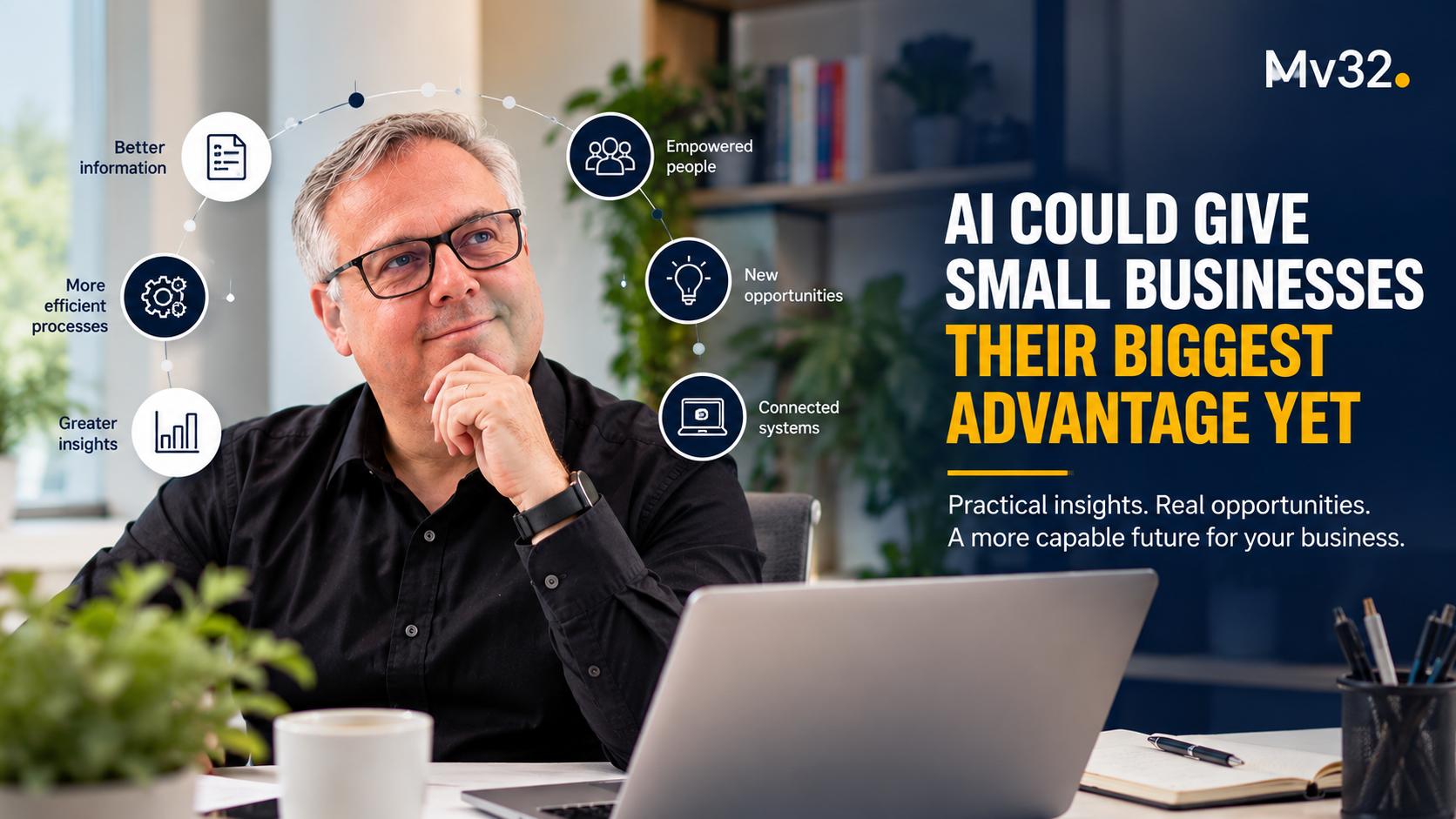
AI is changing what a small business can afford to be. For decades, there was a fairly simple relationship between size and capability. Large organisations could afford sophisticated systems, specialist teams, extensive automation and the technology infrastructure needed to connect everything together. Smaller businesses often had to make do with spreadsheets, manual processes and people doing work that technology could have handled.
AI is beginning to change that equation. Capabilities that once required substantial technology budgets are becoming accessible to organisations with much smaller teams. But there is an important distinction: having access to AI is not the same as knowing how to use it to build a better organisation.
At Mv32, we believe you are the intelligence, AI is the assistant. The opportunity is not to hand your business over to AI, but to give your people better tools to work with.
The opportunity is bigger than another AI tool
When many business owners think about AI, they think about generating emails, summarising documents or asking a chatbot a question. Those applications can certainly save time, but they are only part of the opportunity.
The more interesting question is what happens when AI becomes connected to the way the organisation actually operates. Customer enquiries could be handled more efficiently. Information from different systems could be brought together. Reports could be produced without someone spending hours manipulating spreadsheets. Internal knowledge could become easier for people to find and use.
That is a very different proposition from simply giving everyone another AI subscription. It is about building capability into the organisation itself.
And this is something I have seen first-hand through a current project with a client in the education sector.
AI should enhance people, not replace them
Recently, I received a review from a client I am currently working with on the development of their website and a Learning Management System for qualifications offered by the Macmillan Centre for Learning.
One part of their feedback particularly stood out to me. They said they were impressed by my approach to using AI in an academic context, specifically the belief that AI can support the development of learners without replacing the knowledge and skills they need to develop themselves.
That distinction is important far beyond education.
The same principle applies to business. If AI simply produces the answer, completes the task or makes the decision for someone, we may have automated something, but we haven't necessarily made the organisation better. The more valuable question is how AI can help people work more effectively while keeping human judgement, expertise and responsibility where they belong.
My client described the systems we are developing as ones that enhance the educational experience rather than simply provide answers and perform tasks that are core skills.
I think there is a useful lesson here for every SME considering AI.
The objective isn't to remove human capability. It is to amplify it.
Start with the business, not the technology
This is where I think many SMEs are approaching AI from the wrong direction.
The question should not be, “What AI tool should we buy?” It should be, “Where is our organisation losing time, capacity or information?” Look at the processes that people repeat every day. Look for information that gets copied from one system to another. Look at the reports someone spends hours assembling. Look at customer enquiries that require information to be gathered from several different places.
These are business problems first and technology problems second.
My client also commented on the way I approach this kind of work, saying that I communicate to gain a clear understanding of what they require, while also looking for ways to achieve the best outcome. They mentioned that I had presented solutions they had not thought of, while still being willing to listen when something required a specific approach.
That, to me, is what good technology implementation should look like. You start by understanding the organisation. Then you work out what technology can do to improve it.
Excel isn't the problem. Knowing when you've outgrown it is
There is nothing inherently wrong with Excel. It is flexible, familiar and remarkably useful, which is precisely why so many SMEs rely on it.
The problem starts when spreadsheets become the infrastructure holding the business together. Multiple versions appear, information gets duplicated, formulae become difficult to understand, and nobody is completely sure which document contains the latest figures.
At that point, the issue isn't really Excel. The issue is that the organisation has outgrown the way information is being managed.
Connected systems can change that. Instead of people repeatedly moving information between systems, data can flow between them automatically. Add AI to that connected environment and the organisation can begin to interpret information, assist people with decisions and handle increasingly sophisticated tasks.
The objective isn't to eliminate people. It is to eliminate unnecessary friction.
The real advantage is organisational capability
The most interesting thing about AI for SMEs isn't necessarily saving a few hours here and there. It is the possibility of increasing what a relatively small organisation is capable of doing.
A ten-person business cannot suddenly become a 500-person organisation. But it can potentially access some of the information, automation and analytical capabilities that previously required a much larger team. That might mean responding faster to customers, reducing administration, improving management visibility or giving people more time to concentrate on business development and strategy.
And this is where I think the current AI opportunity becomes particularly interesting. Smaller organisations can increasingly access sophisticated capabilities without needing to build the kind of technology infrastructure that would once have required a much larger budget.
But technology alone isn't the advantage.
The advantage comes from knowing how to apply it.
My client's review ended by saying that their experience had led them to look at new possibilities for the learning and assessment process. That is exactly the kind of outcome I want from this work: not dependency on technology, but people seeing new possibilities because they understand what is now possible.
Using AI well is a skill, not a subscription
There is another principle that matters when introducing AI into an organisation: using AI well is a skill, not a subscription.
Buying software doesn't automatically create capability. Your people need to understand what the technology can do, where it fits into their work and where human judgement still needs to remain firmly in control.
That is why Mv32 takes an expert-led rather than tool-led approach. The aim isn't to keep organisations dependent on an external consultant or particular piece of software. It is to help people understand what they are doing and become more capable themselves.
The technology will continue to change. The ability to identify a useful business problem, understand the available technology and apply good judgement will remain valuable.
So where should an SME start?
Start with the organisation rather than the AI.
Identify the repetitive processes, administrative bottlenecks, disconnected systems, duplicated information and decisions that require someone to manually assemble data. Then ask a simple question: “If we redesigned this process today, knowing what AI and modern technology can now do, would we build it this way?”
You don't need to automate everything. You don't need to replace your existing systems. And you certainly don't need to chase every new AI tool that appears.
The goal is to identify the changes that could genuinely make your organisation more efficient, more connected and more capable.
If you'd like to explore where AI could genuinely help your organisation, I offer a free 30-minute discovery call. It's simply a conversation about how your organisation currently works and where AI, automation or better-connected systems might create useful opportunities. There is no obligation and no sales pitch.
What is the one process in your organisation you would most like to stop doing manually?
Could AI take the busywork off your plate?
Book a free 30-minute discovery call with Simon. No pitch, just an honest look at where your time goes and what could change.
Book a discovery callI post on LinkedIn every day about practical AI, running a small business and what I'm learning along the way. Connect with me there and join the conversation.
Connect on LinkedIn